Ashwagandha: benefits, dosage and side effects
By the Naturomag editorial team · Published
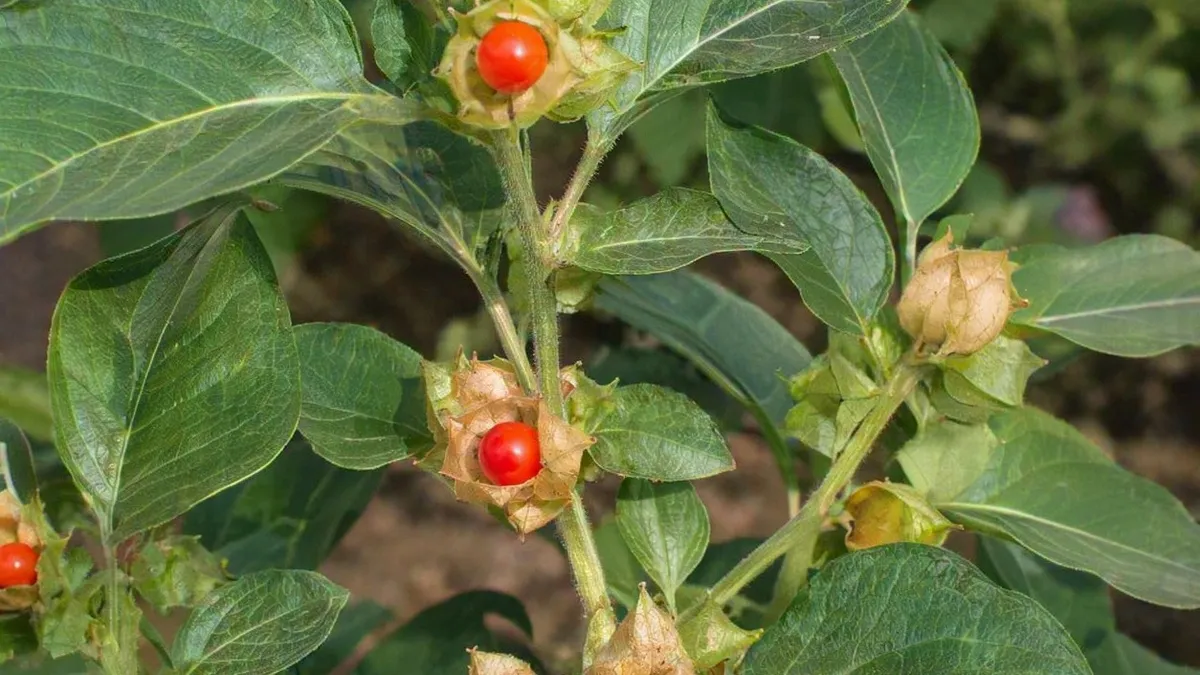
Ashwagandha (Withania somnifera) is a shrub root used in Ayurveda, and the research points mainly to 2 things: some preparations may help with stress and insomnia. The trials used about 240 to 600 mg of extract a day for 8 to 10 weeks. Here are the numbers, then the cautions.
- Latin name
- Withania somnifera
- Also called
- Indian ginseng
- Part used
- Root, leaf or both
- Daily amounts in the trials below
- 240 to 600 mg of extract
- Length of short-term use
- up to 3 months (NCCIH)
What is ashwagandha?
An evergreen shrub that grows in parts of India, Africa and the Middle East. Ayurvedic practice has used it for thousands of years. Its signature compounds are called withanolides, and supplements are made from the root, the leaf or a mix. It belongs to the group marketed as "adaptogens", plants sold to help the body cope with stress.
What does ashwagandha do, according to trials?
The most consistent results concern perceived stress and sleep. The National Center for Complementary and Integrative Health (NCCIH, March 2023) says some preparations may help with insomnia and stress, while the picture for anxiety is unclear. These 4 randomized, placebo-controlled trials show what was measured:
| Trial | People | Daily amount, length | Result reported |
|---|---|---|---|
| Chandrasekhar, 2012 | 64 adults with chronic stress | 600 mg, 60 days | Lower stress scores and lower serum cortisol than placebo |
| Salve, 2019 | 60 stressed healthy adults, 58 finished | 250 or 600 mg, 8 weeks | Lower perceived stress at both amounts, better sleep quality |
| Lopresti, 2019 | 60 stressed healthy adults | 240 mg, 60 days | Lower anxiety scale scores and morning cortisol |
| Langade, 2019 | 60 randomized, 58 analyzed | 600 mg, 10 weeks | Faster sleep onset and better sleep quality |
These are small studies with different extracts, so a result belongs to the preparation that was tested more than to every capsule on the shelf.
What do pooled trials say about stress and anxiety?
A 2024 meta-analysis of 9 randomized trials with 558 participants found lower scores than placebo on a perceived stress scale and an anxiety scale, and lower blood cortisol. 4 of the 9 trials reported mild to moderate adverse events. The authors ask for more information on long-term safety. On anxiety alone, NCCIH (2023) still judges the evidence unclear.
Does ashwagandha raise testosterone or help men?
It may raise testosterone and improve sperm quality over 2 to 4 months, on limited evidence. That is the NCCIH reading. The 2019 Lopresti trial at 240 mg a day found no significant testosterone difference against placebo. Evidence on female infertility and menopause is too thin to draw a line.
What about ashwagandha for weight loss, skin or the gym?
Stress and sleep carry the research; these other goals do not have the same backing. NCCIH rates the evidence on athletic performance and cognition as insufficient. Skin and weight claims on labels rest on much less than the stress trials above, so treat a product sold for them as an experiment, not a known effect.
How much ashwagandha is used per day?
The trials give the working range. They split 600 mg into 2 capsules of 300 mg, or gave 240 to 250 mg a day. Compare labels on 3 points:
- Plant part: root only, or root and leaf.
- Extract or plain powder: 600 mg of powder is not 600 mg of concentrated extract.
- Withanolide content, stated as a percentage. KSM-66, a branded root extract you will see often, is one such standardized form.
Tinctures follow their own ratios, so the milligram figures from capsule trials do not carry over to drops.
When and how long do people take ashwagandha?
In the trials, daily for 8 to 10 weeks, often split into a morning and an evening capsule. The Langade sleep study and the Chandrasekhar stress study both used 300 mg twice a day. Lopresti gave 240 mg once a day. Salve compared 125 mg and 300 mg, each taken twice daily.
None of these schedules runs past 10 weeks, which fits the NCCIH window of up to 3 months for short-term use. A product that promises an effect the same evening goes further than these studies: results were read after weeks, not hours.
How should you read the trial results?
As encouraging signals from small groups. Each study counted about 60 people. Stress and sleep scores are filled in by participants, and cortisol, a stress hormone measured in blood, was added in several of them. NCCIH notes that many trials exist but use different preparations, which makes them hard to pool. Match the extract, the amount and the length before expecting a published result from your own bottle.
What are the side effects of ashwagandha?
Drowsiness, stomach upset, diarrhea and vomiting are the ones reported. Rare cases of liver injury have been linked to ashwagandha supplements. Safety beyond 3 months has not been established.
What did the liver injury reports look like?
Jaundice and itching that started 2 to 12 weeks after the first dose, in the cases described. A 2020 case series from Iceland and the US Drug-Induced Liver Injury Network gathered 5 people, aged 21 to 62, with nausea, tiredness, itching and abdominal discomfort. None developed liver failure, and liver tests returned to normal within 1 to 5 months in the 4 who were followed. Some were also taking other supplements. Yellow skin or eyes and unusual itching are signs to stop the product.
Can ashwagandha change thyroid hormones?
It did in 1 small trial, which is why thyroid conditions are on the caution list. In 50 adults with mildly raised TSH, 600 mg of root extract a day for 8 weeks changed TSH, T3 and T4 levels compared with placebo. Anyone who takes thyroid hormone has an interaction to take into account.
Who should not take ashwagandha?
NCCIH lists clear groups.
- Pregnancy: avoid it; not for use while breastfeeding.
- People scheduled for surgery.
- Autoimmune or thyroid disorders.
- Hormone-sensitive prostate cancer, because testosterone may rise.
It may interact with drugs for blood sugar or blood pressure, immunosuppressants, sedatives, anti-seizure drugs and thyroid hormone.
Where does ashwagandha fit in herbal training?
It is one of the plants that show why a herbalist reads preparation, dose and interactions together. Programs that teach this are compared in our guide to herbalist training programs. For another supplement plant with a monograph behind it, see turmeric root and its dose table; every plant is listed under medicinal herbs.
Frequently asked questions
How long did the sleep trial run?
10 weeks, with 300 mg of root extract twice a day (Langade, 2019).
Is ashwagandha the same as ginseng?
No. "Indian ginseng" is a nickname; the plant is Withania somnifera, not a Panax species.
Sources
- Ashwagandha: Usefulness and Safety, NCCIH, 2023
- Chandrasekhar K. et al., ashwagandha root extract and stress, Indian J Psychol Med, PubMed, 2012
- Salve J. et al., ashwagandha root extract in healthy adults, Cureus, PubMed, 2019
- Lopresti A. L. et al., ashwagandha extract and stress, Medicine, PubMed, 2019
- Langade D. et al., ashwagandha root extract and sleep, Cureus, PubMed, 2019
- Effects of Ashwagandha on stress and anxiety: a systematic review and meta-analysis, Explore (NY), 2024
- Ashwagandha-induced liver injury: a case series, Liver International, 2020
- Ashwagandha root extract in subclinical hypothyroid patients, Journal of Alternative and Complementary Medicine, 2018