Ayurveda: meaning, doshas and everyday practice
By the Naturomag editorial team · Published
Ayurveda is the traditional medical system of India, more than 4,000 years old, built on the balance of 3 qualities called doshas: vata, pitta and kapha. Its name is usually translated as "the science of life", and it works through diet, herbs, massage, yoga, meditation and daily routine.
- Origin
- India, over 4,000 years ago (MSD Manual)
- Meaning
- "The science of life"
- The 3 doshas
- Vata, pitta, kapha
- Main tools
- Diet, herbs, massage, yoga, meditation, cleansing
- US certification
- From 600 hours of education (NAMACB)
What does Ayurveda mean and where does it come from?
The word is read as "the science of life", the translation Kerala Ayurveda Academy uses; the National Ayurvedic Medical Association (NAMA) renders the Sanskrit term as "knowledge of life". The system rests on ancient Indian writings, takes a whole-person view of physical and mental health, and remains one of India's traditional health care systems according to the National Center for Complementary and Integrative Health (NCCIH).
Its theory links health to prana, the life force. When the doshas are in balance, prana is said to be balanced too. The World Health Organization has also started work on an ICD-11 module derived from Ayurveda and related systems.
What are the 3 doshas?
Vata, pitta and kapha are 3 bodily qualities, and each person has a mix of their own, most often with 1 that leads (MSD Manual). Practitioners use that mix to shape advice: 2 people with the same goal may receive different meals, routines and herbs.
An online dosha quiz asks about your build, sleep, appetite and temperament. It gives a first sketch. A consultation adds direct observation, which a form on a screen cannot capture.
Which elements and qualities define each dosha?
Each dosha combines 2 of the 5 elements of the system: space (or ether), air, fire, water and earth. The Ayurvedic Institute lists their qualities, and its introductory guide gives each one a job in the body:
| Dosha | Elements | Role | Some qualities | In balance, in the tradition |
|---|---|---|---|---|
| Vata | air and space | movement, including breathing and blinking | dry, light, cold, rough, mobile | creativity, flexibility |
| Pitta | fire and water | digestion, metabolism, body temperature | hot, sharp, light, oily, liquid | understanding, intelligence |
| Kapha | earth and water | structure and lubrication | heavy, slow, cold, oily, soft, static | steadiness, love, forgiveness |
Out of balance, the same guide associates vata with fear and anxiety, pitta with anger and jealousy, and kapha with attachment and greed. Everyone has all 3; usually one comes first, another second and the third least.
The institute also separates 2 ideas. Your constitution is set at conception and stays the same for life. Your current state can drift from it with diet, seasons, stress, work and relationships, and that drift is what a practitioner tries to correct.
What is the rule of opposites, and what is agni?
To offset an excess, Ayurveda adds the opposite quality. The National Ayurvedic Medical Association explains that the classical texts sort every experience into 10 pairs of opposite qualities, 20 in all, called gunas: heavy against light, for instance. Someone who feels cold and dry is steered toward warm and moist; someone who feels heavy toward light.
The second key idea is agni, the "digestive fire". It names the power of transformation that turns food into tissue and waste, and information into understanding. When agni is weak, the tradition speaks of ama, undigested material that builds up.
NAMA also describes 8 classical branches, among them internal medicine, pediatrics, geriatrics and rejuvenation, toxicology and surgery, the last of which is not practiced in the United States today.
What happens in an Ayurvedic consultation?
Expect questions, observation and a pulse reading. The MSD Manual lists how practitioners evaluate a person:
- Questions about complaints, behavior and lifestyle.
- A look at the whole appearance, including eyes, tongue and skin.
- The pulse, and in some practices urine and stool.
- A plan fitted to the dosha balance found.
Bring a list of what you take each day, supplements included, and a few days of notes on meals and sleep. A good first visit uses that detail.
What does an Ayurvedic diet and routine look like?
Meals and habits are chosen to suit your dosha balance and your life, not copied from a single menu. Food is the part most people try first, alongside regular timing, movement, breathing and rest. Yoga and meditation belong to the same toolkit.
Whether your question is weight, sleep or menopause, the starting point in this tradition is the same: a program of meals and routine matched to your dosha mix. A fair test of any program is whether you can keep it for several weeks.
Which foods go with each dosha?
The food chart follows the state you are in now, not only your basic constitution. The food guidelines of the Ayurvedic Institute start by naming the signs of an excess, then apply the rule of opposites.
| Excess felt | Signs listed | Fruits favored | Vegetables favored |
|---|---|---|---|
| Vata | gas, cold, dryness, constipation, anxiousness | sweet fruit, cooked apples, bananas, berries, mango | cooked vegetables: carrots, asparagus, sweet potato, pumpkin |
| Pitta | hyperacidity, heat, irritability | sweet fruit: melons, pears, ripe mango, red grapes | sweet and bitter ones: cucumber, broccoli, kale, zucchini |
| Kapha | congestion, heaviness, sluggishness | astringent fruit: apples, pears, cranberries, pomegranate | see the full chart |
The chart also asks vata types to go easy on raw apples and most dried fruit, pitta on sour fruit and hot peppers, kapha on bananas, coconut and melons. Fruit is best eaten apart from full meals in this view. The institute presents these lists as general, to be adjusted for allergies, digestion and season.
What is dinacharya, the Ayurvedic daily routine?
It is a set sequence of morning habits meant to keep body and mind on a steady clock. The version published by the Ayurvedic Institute includes:
- Waking before sunrise, on average about 6 a.m. for vata, 5:30 for pitta and 4:30 for kapha.
- Rinsing the face, mouth and eyes with water.
- Drinking a glass of room temperature water.
- Going to the toilet at a set time.
- Scraping the tongue from back to front, 7 to 14 strokes.
- Brushing the teeth, then swishing warm sesame oil.
- Rubbing warm oil over the scalp and body, a practice called abhyanga.
The list goes further, with nose and ear drops among other steps. Most people start with 2 or 3 habits that fit their morning, such as water, tongue scraping and a few minutes of quiet, then add more.
What are Ayurvedic massage, oils and panchakarma?
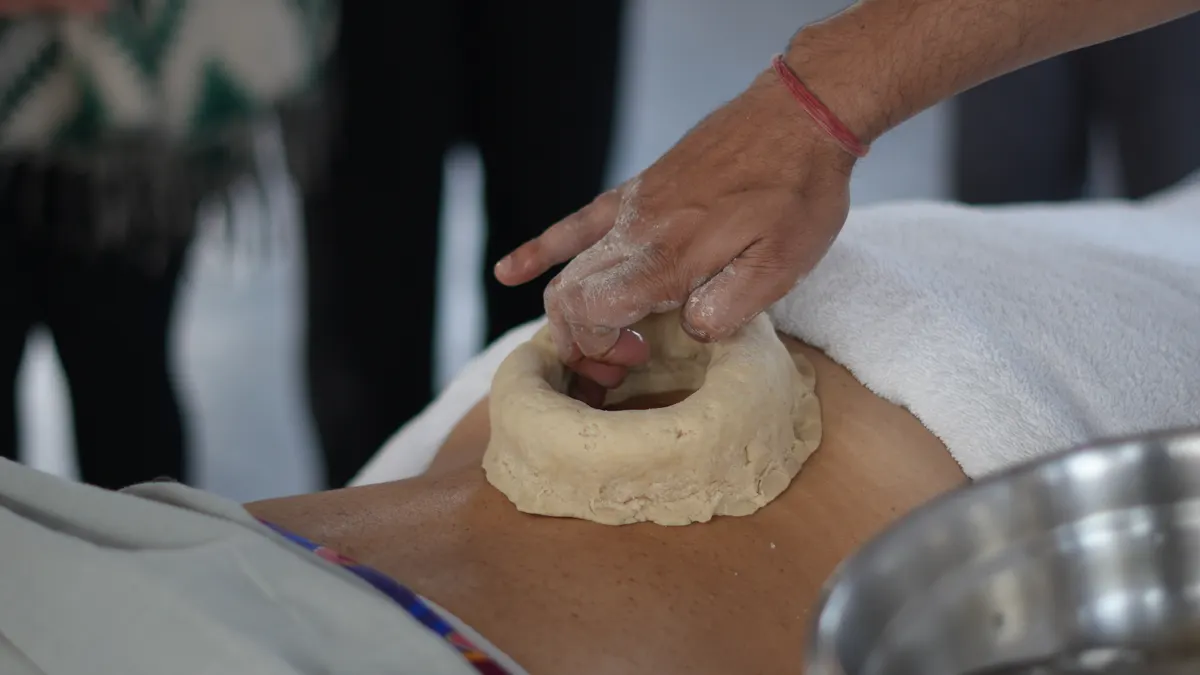
Oil is central to Ayurvedic body care. Familiar forms include oil massage, head massage, hair oiling and kati basti, shown on this page, where warm oil is held on the lower back inside a ring of dough.
Panchakarma is the name of the tradition's cleansing programs. The MSD Manual describes internal cleansing in Ayurveda as typically an enema or rinsing the nose with water. It is a bigger step than a massage, so ask exactly which procedures a program includes before you book.
What are the stages of panchakarma?
Preparation first, then 1 or more of 5 cleansing actions, chosen for the person. "Panchakarma" literally means 5 actions. The Ayurvedic Institute describes 2 preparatory steps given daily for 3 to 7 days: snehan, a full body oil massage, and svedana, therapeutic sweating with steam.
| Cleansing action | What it is |
|---|---|
| Vamana | induced vomiting |
| Virechan | purging with herbal laxatives |
| Basti | medicated enema |
| Nasya | substances given through the nose |
| Rakta moksha | blood purification; the institute uses herbal protocols and does no bloodletting |
It places a focused program at 7 to 10 days, a traditional one at 14 to 21 days and an extended one at 28 days or more. It asks for particular care with pregnancy and breastfeeding, active infections or acute illness, recent surgery, certain heart conditions and, for some procedures, menstruation.
What do studies show about Ayurveda?
The research base is still small. NCCIH says only a limited number of clinical trials have been published in Western medical journals. The one it describes in most detail dates from 2013: 440 people with knee osteoarthritis took 1 of 4 products, 2 of them Ayurvedic plant formulations, and all 4 groups reported similar reductions in pain and gains in function (NCCIH).
A result like this belongs to the exact formulation tested. It does not carry over to every blend that shares an herb with it.
NCCIH cites other early work: a 2011 pilot with 43 people with rheumatoid arthritis, comparing a conventional drug with a blend of 40 herbal compounds, found them similarly effective; a short trial in 89 people tested 5 herbs for type 2 diabetes, with design weaknesses that keep researchers from firm conclusions; and 2 small studies, in 10 and 89 people, looked at turmeric in ulcerative colitis. About 240,000 American adults use Ayurvedic medicine, by its count.
Are Ayurvedic herbs and products safe?
Some preparations contain lead, mercury or arsenic at levels that can be toxic. NCCIH reports a 2015 survey in which 40% of people using Ayurvedic preparations had raised blood lead levels, and some had raised mercury. Metals can come from contamination or be part of a recipe.
When choosing a product, look for:
- a named manufacturer and a batch number;
- a published heavy metal analysis for that batch;
- a full ingredient list with Latin plant names.
For one of the best studied plants of the tradition, see the trial table in our guide to ashwagandha root.
How do you choose an Ayurvedic practitioner?
Ask about training hours and certification, since the title alone says little in the US.
- How many hours of Ayurvedic study did they complete, and at which school?
- Do they hold a NAMA Certification Board title, which requires a course of study, an exam and continuing education?
- What will the first visit cover: history, pulse, tongue, diet and routine?
- Where do their herbal products come from, and is there a heavy metal test for the batch?
- Which parts of the plan can you start with food and routine alone?
If your goal is a career, compare programs on the same lines before looking at the price.
How do you train in Ayurveda in the United States?
No state requires a license to practice Ayurveda (NCCIH), so training hours and professional certification are what set practitioners apart. The NAMA Certification Board certifies 3 levels:
| Certification | Education required |
|---|---|
| Ayurvedic Health Counselor | 600+ hours, US-based |
| Ayurvedic Practitioner | 1,500 to 2,500 hours, US-based |
| Certified Advanced Ayurvedic Practitioner | 4,000+ hours |
3 examples from school websites, checked on November 27, 2026: California College of Ayurveda lists a foundation program of about 6 months and 681 hours, online or in Nevada City, California, with total charges of $6,994; Kerala Ayurveda Academy lists a 1-year, 600-hour counselor program at $8,950; The Ayurvedic Institute teaches in Asheville, North Carolina. Internationally, the World Health Organization published training benchmarks for Ayurveda for national authorities.
What does the full study path look like?
Schools usually stack the levels, so you can stop at the first or go on. The Ayurvedic Institute shows a 4-month wellness coach program, then a first year for the Ayurvedic Health Counselor, a second for the Ayurvedic Practitioner and years 3 and 4 for the advanced practitioner level. Kerala Ayurveda Academy lists a 6-month, 300-hour beginner certification at $3,850, its 600-hour counselor program at $8,950 and a 3-year, 2,500-hour practitioner program, in live online, in-person or hybrid formats depending on the course.
Frequently asked questions
How old is Ayurveda?
The MSD Manual dates its origin to more than 4,000 years ago. The National Ayurvedic Medical Association speaks of roots going back over 5,000 years.
Is Ayurveda the same as Chinese medicine?
No. They are separate systems with separate theories: Ayurveda reasons in doshas, while Chinese medicine reasons in qi, yin and yang.
Can you have 2 dominant doshas?
Descriptions of the system say most people have 1 leading dosha, and the exact balance among the 3 is individual. Many quizzes report a pair when 2 scores are close.
What is the difference between vata, pitta and kapha in one line each?
Vata is the principle of movement, pitta of digestion and transformation, kapha of structure and lubrication.
Sources
- Ayurvedic Medicine: In Depth, NCCIH
- Ayurveda, MSD Manual Consumer Version, 2025
- WHO benchmarks for the training of Ayurveda, World Health Organization, 2022
- Certifications offered, NAMA Certification Board
- National Ayurvedic Medical Association, National Ayurvedic Medical Association
- Principles of Ayurvedic Medicine program, California College of Ayurveda
- Academy courses and tuition, Kerala Ayurveda Academy
- The Ayurvedic Institute, The Ayurvedic Institute
- What is Ayurveda?, National Ayurvedic Medical Association
- Traditional medicine chapter of ICD-11, World Health Organization
- Doshas, their elements and attributes, The Ayurvedic Institute, 2021
- Ayurveda: a brief introduction and guide, The Ayurvedic Institute, 2021
- Ayurvedic food guidelines, The Ayurvedic Institute, 2021
- Dinacharya: the Ayurvedic daily routine, The Ayurvedic Institute, 2021
- Introduction to panchakarma, The Ayurvedic Institute
- Resources and study programs, The Ayurvedic Institute