Hildegard of Bingen: her life and her writings on healing
By the Naturomag editorial team · Published
Hildegard of Bingen (1098 to 1179) was a German Benedictine abbess, visionary, composer and writer, whose books on nature and healing are the Physica and Causae et curae. Pope Benedict XVI proclaimed her a Doctor of the Church on October 7, 2012.
- Born
- 1098, Bermersheim near Alzey
- Died
- September 17, 1179, Rupertsberg near Bingen
- Healing books
- Physica, Causae et curae
- Best known visionary work
- Scivias
- Doctor of the Church
- Since October 7, 2012
Who was Hildegard of Bingen?
A nun who led communities, wrote and preached in the 12th century. According to the apostolic letter of 2012, she was received at the abbey of Disibodenberg at age 8, made her profession there in 1115 and became leader of the women's community around 1136. Around 1150 she moved with 20 sisters to a new monastery on the Rupertsberg, and in 1165 she founded a second one across the Rhine.
From childhood she reported visions. Pope Eugene III authorized her in 1147 to write and speak in public, and she later preached in cathedral cities such as Cologne, Trier and Mainz.
What are the key dates in her life?
| Year | Event |
|---|---|
| 1098 | Born at Bermersheim, near Alzey, into a wealthy noble family |
| About 1106 | Received at age 8 at the Benedictine abbey of Disibodenberg |
| 1115 | Makes her religious profession |
| About 1136 | Succeeds Jutta of Sponheim as leader of the women's community |
| 1141 | Begins to write down her visions; starts Scivias |
| 1147 | Pope Eugene III authorizes her to write and speak in public |
| About 1150 | Moves to the Rupertsberg, near Bingen, with 20 sisters |
| 1165 | Founds a second monastery across the Rhine |
| 1179 | Dies on September 17 at the Rupertsberg |
| 2012 | Enrolled among the saints and declared Doctor of the Church |
Dates follow the apostolic letter of 2012 and the Abbey of St. Hildegard.
How was she educated?
Through the monastic life rather than the schools. Her contemporary biography, the Vita, gives her 9 brothers and sisters. The apostolic letter dates her reception at Disibodenberg to age 8, while the abbey in Eibingen, following the Vita, says she was entrusted at 14 to the recluse Jutta of Sponheim, who lived in a hermitage beside the monastery.
There she grew up with the Benedictine rhythm of prayer and work, study and reading. She later called herself unlearned, which the abbey takes to mean that she had no formal training in dialectic, rhetoric or grammar. Her knowledge of the Bible, theology, philosophy and natural history was broad, fed by the liturgy, the Rule of Saint Benedict and the Church Fathers. Up to her 41st year, her days followed the regular course of cloistered life; the great output came after.
Success brought friction too: the German broadcaster WDR reports that her thriving new convent on the Rupertsberg drew the envy of other abbesses, and that she had to face recurring rumors.
What did she say about her visions?
She described a light that opened the meaning of Scripture. The abbey in Eibingen quotes her account: in 1141, when she was 42 years and 7 months old, a fiery light with lightning came from heaven, and she heard the instruction "Write down what you see and hear!"
The visions were not new to her: she had received them since childhood. Pope Benedict XVI explained in a 2010 address that she began dictating them to the monk Volmar, her spiritual director, and to her sister Richardis, and that she first sought the judgment of wise people, fearing illusion. Bernard of Clairvaux reassured and encouraged her. At a synod in Trier in 1147, Pope Eugene III read a text she had dictated and gave her permission to write her visions and speak in public. Her contemporaries came to call her the "Teutonic prophetess".
In a letter to Bernard she explained that she saw these things in spirit, not with the eyes of the body (address of September 8, 2010). The Catholic Encyclopedia adds that she had been a sickly child, often barely able to walk, and that she worked on Scivias for 10 years.
What did she write?
Theology, music, letters, and works on nature and medicine.
| Work | Subject |
|---|---|
| Scivias | 35 visions on the history of salvation |
| Liber Vitae Meritorum, Liber Divinorum Operum | Her 2 other major visionary books |
| Physica | Natural science: plants and other creatures, and their uses |
| Causae et curae | Causes of ailments and remedies |
| Symphonia | Her sacred songs |
About 400 of her letters survive (Vatican).
Each of the 3 visionary books has its own subject. Scivias, short for "know the ways", runs from creation to the end of time. The Liber Vitae Meritorum stages the contest between virtues and vices. The Liber Divinorum Operum, which many consider her masterpiece, presents creation in its relation to God with the human being at the center (Vatican, 2010).
The apostolic letter also counts 58 sermons addressed to her sisters, commentaries on Gospel passages, and 2 linguistic works, including an invented language. For medicine it names the Liber Subtilitatum Diversarum Naturarum Creaturarum and Causae et curae, and lists the Physica under natural sciences.
Why did popes, bishops and an emperor write to her?
Her reputation made her a counselor far beyond her convent. About 400 letters survive, addressed to ordinary people, religious communities, popes, bishops and civil authorities. When Emperor Frederick Barbarossa backed rival popes against Alexander III, she warned him in writing that he too was subject to God's judgment (Vatican, 2010).
Late in life, despite frail health, she traveled to preach. The apostolic letter names Cologne, Trier, Liège, Mainz, Metz, Bamberg and Würzburg, unusual journeys for a woman of her time. She spoke out against the Cathar movement, called for reform of the clergy through repentance rather than a change of structures, and did not spare monasteries in her criticism.
Her last year brought a conflict. A young man once excommunicated had been buried in her convent's cemetery, and the Mainz authorities ordered the body removed. Holding that he had been reconciled by receiving the last sacraments, she refused; her convent was placed under interdict, and after much correspondence she had it lifted (Catholic Encyclopedia).
How did she see the human being and nature?
As one whole, body and soul, inside a creation held together by God. The apostolic letter summarizes her view: the human being contains all the elements of the world, the body is not a burden to escape, and even its weaknesses teach humility. She held that man and woman are substantially equal and made for reciprocity, and unlike other medieval authors she did not place the blame for the Fall on Eve's weakness first.
Music belongs to the same picture. For her, the whole creation was a symphony, and sung praise was the human answer to the word that creates. Respect for the laws of nature is one of the themes the letter singles out as speaking to readers today.
Her health advice follows that unity. The medical historian Johannes Gottfried Mayer explains that she tied health to a well-ordered life, saw overindulgence as the source of most illness, praised healthy stomach and bowels, and recommended fasting without overdoing it (interview, in German).
What were Hildegard's remedies based on?
Her own observation, the learning of her time and a religious view of nature. The University of Hohenheim, which shows around 100 of the medicinal plants she used, describes observation, mysticism and speculation woven together, including the old doctrine of signatures: a plant that looks like an organ was thought to act on it. Lungwort, with leaves recalling lung tissue, is its example.
Of the plants in its garden, 46% are native, 24% from southern Europe and 17% from the ancient Near East.
How extensive is the botany? Mayer counts 217 plants and 60 trees described in the Physica. He credits her with the first mention of the marigold with specific uses on the skin, notes her fondness for fennel, and observes that she knew Asian spices such as ginger, nutmeg and galangal. She quotes no other work of her time in her medical books, while drawing on Latin reading and folk knowledge (katholisch.de).
He is just as clear about the limits: some of her plants show real sense, such as marigold, horehound and fennel, others have no effect or are poisonous. Her advice to eat lily of the valley for epilepsy would poison the person, and her recipes with powdered stones belong to medieval belief. Her books are historical sources, not a modern pharmacy.
Which foods and spices are linked to Hildegard?
Spelt above all, with fennel, honey, galangal, pellitory and ginger. katholisch.de reports that she recommended spelt, fennel and honey and classed peas, lavender and leeks among foods to avoid. The German broadcaster WDR, Planet Wissen describes powdered spices kneaded into spelt dough, dried in the sun and eaten by the sick.
A detail most recipe books leave out: the medical historian Johannes Gottfried Mayer states that she wrote no spelt baking recipe. She praised the grain; the modern "Hildegard cookbooks" are adaptations. Mayer also reports her advice to start the day with something warm, such as soup or porridge, and to avoid rich food and overeating.
Wine is part of her table too: more water, beer and diluted wine in summer, wine undiluted in winter, and herbal wines as remedies, such as a horehound wine cooked with fennel and dill. In summer she preferred lightly spiced dishes, in winter more spice; she disliked pork and recommended game (Mayer).
How did Hildegard become a saint and a Doctor of the Church?
It took more than 8 centuries. She was venerated in her lifetime, and popes Gregory IX and Innocent IV ordered inquiries in the 13th century, repeated later, without a formal canonization. Her name nonetheless entered the Roman Martyrology and her feast, September 17, was kept in several German dioceses (Catholic Encyclopedia, 1910).
In 1979, for the 800th anniversary of her death, John Paul II called her a light for her people and her time, and the German bishops, among them Joseph Ratzinger, asked that she be declared a Doctor of the Church. In 2012, as Benedict XVI, he enrolled her among the saints, then conferred the title on October 7, together with Saint John of Avila (apostolic letter).
Where does today's "Hildegard medicine" come from?
From the Austrian physician Gottfried Hertzka, who from the 1960s drew a health concept out of her works (interview with J. G. Mayer, 2017). Spelt took a central place in it, and a whole range of products followed. When you read a "Hildegard" label, check whether the claim comes from the medieval text or from this 20th century revival.
How can you try her approach today?
- Start with food: a warm breakfast, spelt in place of another grain, spices used with a light hand.
- Read a translation of the Physica to see the original wording on a plant before buying anything named after her.
- Learn each plant as herbalists do today, with its Latin name, preparation and safety record, as in our medicinal herb guides.
How has each era seen Hildegard?
Differently every time. The Land der Hildegard network traces 8 centuries of readings:
| Period | The Hildegard it saw |
|---|---|
| Middle Ages | A herald of the approaching end of the world |
| Humanism | The first great woman of literary history |
| Reformation | A witness against abuses in the papal church, which she had denounced in blunt words |
| Romanticism | A saint of the people, wrapped in legends of wonders |
| Industrial age onward | The source of a holistic "Hildegard medicine" offered as a gentle alternative |
| Today | A pioneer for women, a composer especially known in the United States, Australia and Japan, and a guide for thinking about creation and climate |
Knowing which Hildegard a book or a product is selling helps you judge it.
Where can you follow in her footsteps?
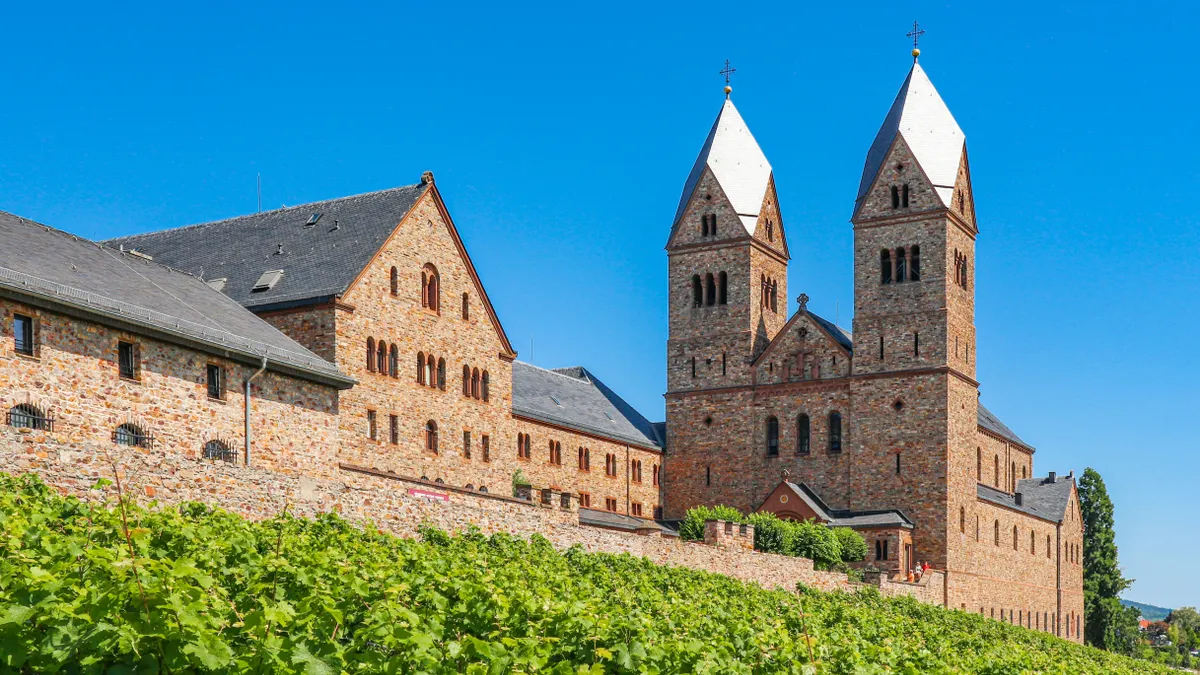
On the Rhine. The Abbey of St. Hildegard in Eibingen, above Rüdesheim, carries her name and tells her story. To study plants and nutrition as a profession, herbal and naturopathic programs are a natural route. For other systems of the same family, read about Indian Ayurveda or browse traditional medicine systems.
Her places can be visited. The original Rupertsberg convent was destroyed in 1632 and her relics went first to Cologne, then to Eibingen, where they were placed in the parish church. The present abbey of St. Hildegard, rebuilt from 1900, is the legal successor of her 2 foundations. The Land der Hildegard network links the Disibodenberg monastery ruins, the Museum am Strom in Bingen with its Hildegard garden, a pilgrimage trail and, since 2023, a permanent exhibition in Niederhosenbach.
Frequently asked questions
Is Hildegard of Bingen a saint?
Yes. In 2012 the Catholic Church formally enrolled her among the saints and proclaimed her a Doctor of the Church.
Did Hildegard write music?
Yes: hymns, antiphons and songs gathered in the Symphonia, performed in her monasteries and still known today.
What language did she write in?
Latin. She also invented a language of her own, the Lingua Ignota.
How did Hildegard of Bingen die?
She fell ill in the summer of 1179 and died on September 17, surrounded by her sisters at the Rupertsberg monastery near Bingen (apostolic letter of 2012).
Why is she called the Sibyl of the Rhine?
The name comes from her reputation as a seer: the Catholic Encyclopedia calls her a great seeress and prophetess known as the "Sibyl of the Rhine".
What is Hildegard of Bingen’s feast day?
September 17, the day of her death in 1179.
Sources
- Apostolic letter proclaiming Saint Hildegard of Bingen a Doctor of the Universal Church, Holy See (Benedict XVI), 2012
- General audience: Saint Hildegard of Bingen, Holy See (Benedict XVI), 2010
- The life of Hildegard of Bingen, Abbey of St. Hildegard, Eibingen
- The medicinal plant garden of Hildegard of Bingen, University of Hohenheim
- Kräuterkunde nach Hildegard (interview with J. G. Mayer, in German), katholisch.de, 2017
- Die „Hildegard-Küche“ liegt im Trend (in German), katholisch.de, 2016
- Hildegard von Bingen (in German), Planet Wissen (WDR)
- General audience: Saint Hildegard of Bingen (September 1, 2010), Holy See (Benedict XVI), 2010
- St. Hildegard of Bingen, Catholic Encyclopedia, New Advent, 1910
- Land der Hildegard: places connected with Hildegard (in German), Land der Hildegard, 2026