Traditional Chinese medicine: theory, methods and research
By the Naturomag editorial team · Published
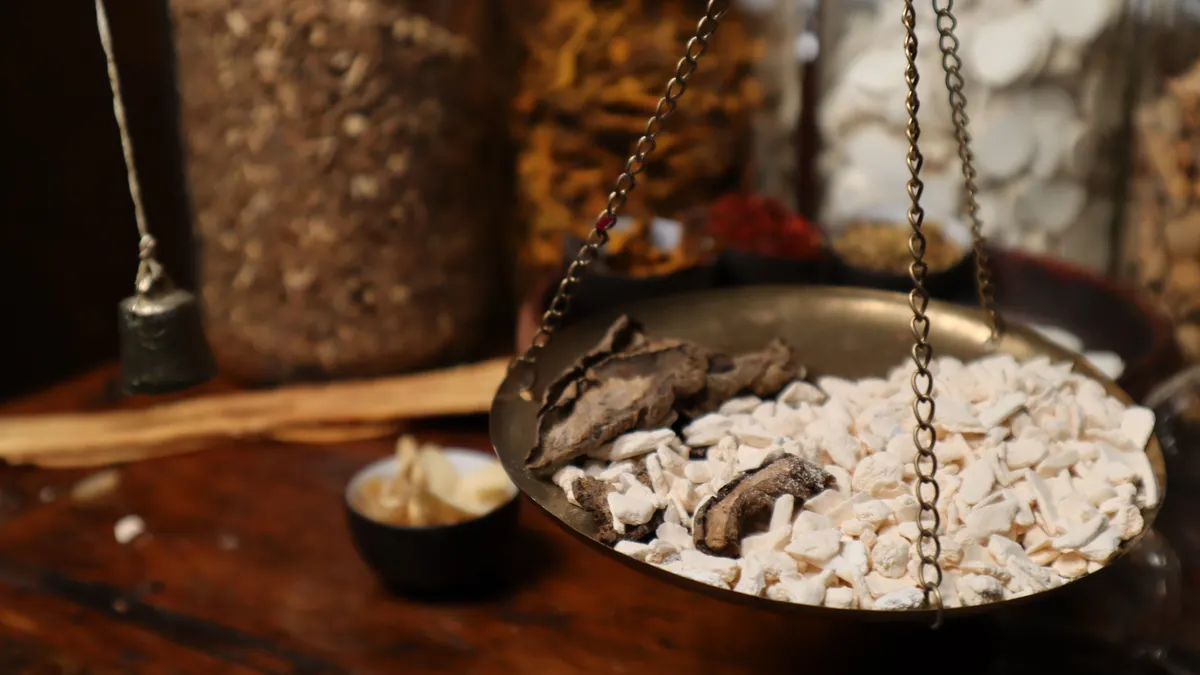
Traditional Chinese medicine (TCM) is a system that began in China several millennia ago and aims to keep qi, the life force, in balance between 2 opposing forces, yin and yang. Its main tools are acupuncture, herbal formulas and qigong, joined by diet, massage and tai chi.
- Core ideas
- Qi, yin and yang
- Most used methods
- Acupuncture, herbs, qigong
- Also part of it
- Diet, massage, tai chi
- International classification
- A chapter of the WHO's ICD-11
What do qi, yin and yang mean?
Qi (said "chee") is the life force; yin and yang are the opposing qualities that shape it. The MSD Manual describes yin as dark and feminine and yang as bright and masculine. In the body they show up as pairs:
| Pair a practitioner weighs | The question behind it |
|---|---|
| Cold and heat | Does the pattern lean chilly or hot? |
| Internal and external | Does it sit deep or at the surface? |
| Deficiency and excess | Is something lacking or overflowing? |
In this theory, illness comes from imbalance, and practice aims to restore it. Terms such as "kidney yin" or "dampness" belong to that language and do not match an anatomy textbook word for word.
What does a TCM practitioner do?
The practitioner combines physical and mind-body methods with herbal products (NCCIH).
- Acupuncture: fine needles at specific points, sometimes with a weak electric current.
- Herbal formulas: mixtures chosen for the person rather than 1 herb alone.
- Qigong and tai chi: slow postures, breathing and attention.
- Diet and massage: food advice and hands-on work.
Methods are often combined, so ask which ones a practitioner is trained and licensed to use.
What does research say about acupuncture?
It may help several kinds of pain. NCCIH names back or neck pain, knee pain from osteoarthritis and pain after surgery. An analysis of 20 studies with 6,376 participants found the benefits lasted 1 year after treatment ended for the conditions studied, neck pain excepted. NCCIH also reports that it may help reduce how often tension headaches occur.
Part of the effect appears to come from expectation and the care setting: the gap is larger against no treatment than against simulated needling.
What about Chinese herbs, tai chi and qigong?
Tai chi and qigong appear safe; results for herbal products are mixed. NCCIH finds tai chi may improve balance in older people and reduce knee osteoarthritis pain. Chinese herbal products have been studied for many problems, with many studies of poor quality and no firm conclusion (NCCIH). The MSD Manual adds that research is hard because formulas vary so much from one source to the next.
What safety points matter with TCM products?
Know exactly what is in the jar. Reports cited by NCCIH found some Chinese herbal products containing:
- undeclared drugs, including the blood thinner warfarin and the anti-inflammatory diclofenac;
- heavy metals such as arsenic, lead and cadmium;
- pesticides, sulfites, microorganisms;
- the wrong herb, with organ damage in some cases.
Ephedra (ma huang), found in many formulas, raises heart rate and blood pressure, and herbs can interact with medicines. With needles, the risks reported by NCCIH come from non-sterile needles or poor technique, which is why training matters.
Is TCM recognized internationally?
The World Health Organization added an optional traditional medicine chapter to its International Classification of Diseases, ICD-11. Its first module covers conditions from traditional medicine that originated in ancient China and is used in China, Japan, Korea and beyond. The WHO presents the chapter as a tool for counting and comparing, not as an endorsement of any method.
How do you become a TCM practitioner in the United States?
Through an accredited program, then a state license. The Accreditation Commission for Acupuncture and Herbal Medicine (ACAHM) is recognized by the US Department of Education for programs in this field. Most states license acupuncturists, with rules that vary, and in most states a national certification or its exams are required (NCCIH on licensing).
Pacific College of Health and Science calls itself the largest school of Chinese medicine in the country, with campuses in San Diego, New York and Chicago. Our comparison of Chinese medicine schools sets programs next to each other.
Needle safety has its own federal rule: the FDA regulates acupuncture needles as medical devices: they must be sterile and labeled for single use (NCCIH).
Frequently asked questions
Is acupuncture all of Chinese medicine?
No. It is the best known method, alongside herbs, qigong, tai chi, diet and massage.
How long has acupuncture been used?
In some form, for at least 2,500 years according to NCCIH. It spread widely outside China from the 1970s.
How does TCM differ from Ayurveda?
The theories differ: qi, yin and yang on one side, and the vata, pitta and kapha doshas of India on the other.
Does health insurance cover acupuncture in the United States?
Some policies do and others do not, and coverage often depends on the condition being treated (NCCIH). Read your plan's acupuncture terms before booking.
Sources
- Traditional Chinese Medicine: What You Need To Know, NCCIH
- Acupuncture: Effectiveness and Safety, NCCIH
- Traditional Chinese Medicine (TCM), MSD Manual Consumer Version, 2025
- Traditional medicine chapter of ICD-11, World Health Organization
- Credentialing, Licensing, and Education, NCCIH
- About ACAHM, Accreditation Commission for Acupuncture and Herbal Medicine
- Pacific College of Health and Science, Pacific College