Lion's mane mushroom: benefits, dosage and studies
By the Naturomag editorial team · Published
The main benefit studied for lion's mane (Hericium erinaceus) is mental performance: small human trials measured better scores on a cognitive scale and faster answers on 1 attention task. The best known gave about 3 g of dried powder a day for 16 weeks, and the gain faded after people stopped.
What is lion's mane mushroom?
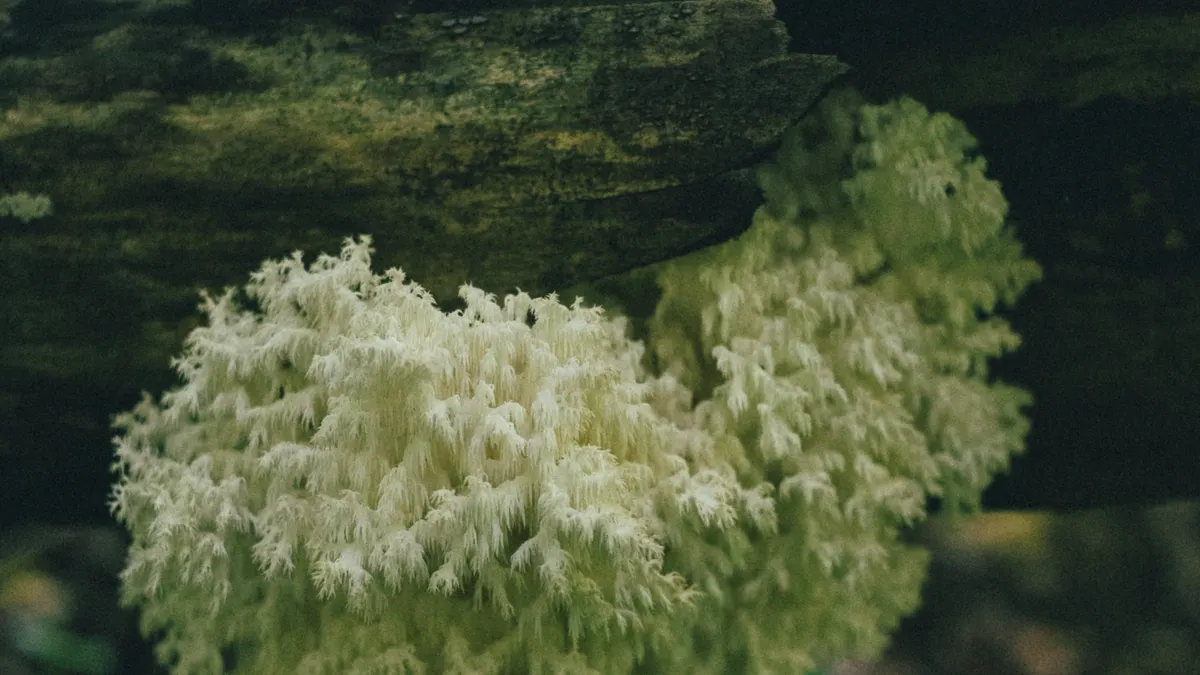
An edible fungus that forms a white cluster of hanging spines on wood. Japanese research calls it Yamabushitake. Shops sell it fresh for cooking, dried, as powder and as capsules or liquid extract. Those forms are not interchangeable: a study result belongs to the one tested.
What are hericenones and erinacines?
They are the 2 families of compounds that made researchers look at this mushroom. Hericenones and erinacines are studied for their links with the signals that help nerve cells grow and survive; erinacines are associated with the mycelium, the root-like network of the fungus, while the fruiting body is the white cluster you can cook. Polysaccharides, including beta-glucans, are the other group often named.
The lab work is where the headlines start. In a 2008 study on human cells and mice, a lion's mane extract raised the production of nerve growth factor (NGF), a protein that supports neurons. Mice fed 5% dry powder for 7 days showed more NGF messenger in the hippocampus, a memory region. In that same work, 3 of the hericenones did not trigger the effect, so the active part is still being mapped.
Cell and animal results show how something might work. What happens in people is what the trials below measured.
Does lion's mane help memory?
The strongest signal comes from 30 Japanese adults aged 50 to 80 with mild cognitive impairment: higher scores on a cognitive scale than with placebo, while they took it. In this double-blind trial (Mori, 2009), half took tablets of 250 mg, 4 at a time, of 96% dry powder 3 times a day. Their cognitive scores beat placebo at weeks 8, 12 and 16, then fell 4 weeks after stopping.
The design was simple: 2 weeks of preliminary examination, 2 randomized groups of 15, 16 weeks of tablets, then 4 weeks of observation. The measure was a scale based on the revised Hasegawa Dementia Scale, a short screening questionnaire used in Japan. Scores in the mushroom group kept rising the longer people took it.
A 12-week placebo-controlled trial (Saitsu, 2019) found a significant effect on the Mini-Mental State Examination, a general cognition test. Its 2 memory tests showed no significant effect.
Is there a longer trial in people with memory disease?
One pilot trial ran for 49 weeks in people with mild Alzheimer's disease, with a mycelium preparation enriched in erinacine A. Participants took 3 capsules of 350 mg a day or identical placebo capsules (Li, 2020). The mushroom group improved on the Mini-Mental State Examination, the placebo group declined on a second cognitive screening score, and the 2 groups differed on daily living activities. 4 people dropped out with abdominal discomfort, nausea or skin rash.
This was a small pilot on a specific mycelium product. Its result does not carry over to a fruiting body powder bought for everyday focus.
What about focus, stress and mood in younger people?
Faster answers on 1 attention task, and a trend on stress that stayed short of significance. Docherty and colleagues (Nutrients, 2023) studied 41 healthy adults aged 18 to 45 with 1.8 g doses. One hour after a single dose, they were quicker on the Stroop task. After 28 days, perceived stress tended to fall (p = 0.051). The authors also report null and some negative findings.
In Japan, 30 women ate cookies with or without the mushroom for 4 weeks (Nagano, 2010). Mood and complaint questionnaire scores fell after intake, and 2 items did better than with placebo.
Those 2 items were labelled insensitivity and palpitation. Concentration, irritability and anxiousness also tended to be lower than with placebo, without reaching the same level of proof. The groups were small, so read these as leads for larger trials.
Does lion's mane work the same day?
Only on narrow tasks, if at all. A 2025 crossover trial gave 18 healthy adults aged 18 to 35 a single dose of 3 g of a 10:1 fruiting body extract, or a placebo. 90 minutes later, the overall scores for cognition and mood did not differ. One test of hand dexterity, the pegboard, came out better with the mushroom.
A 2026 pilot followed 10 healthy adults taking 2 g a day of mycelium and fruiting body for 28 days. Executive function and BDNF, another growth signal, showed no statistically significant change, with small to moderate upward trends and no placebo group.
What have studies measured on sleep and anxious mood?
Early improvements in people who already had complaints. A team in Milan recruited 77 volunteers with overweight or obesity who reported mood, sleep or binge eating difficulties. After 8 weeks of lion's mane alongside a low-calorie diet, scores for depressive and anxious mood and for sleep disturbance had decreased (Vigna, 2019). The diet ran at the same time, so the mushroom's own share is not isolated by the summary of the study.
The Japanese cookie study of 2010 also followed menopause and sleep questionnaires in its 30 women. Its clearest results were the mood and complaint scores described above.
Does lion's mane act on the gut?
A very short pilot saw the gut bacteria shift. 13 healthy adults took lion's mane powder for 7 days (2021 study). The variety of their gut microbiota increased and some bacteria that produce short-chain fatty acids became more abundant. There was no comparison with a placebo, and a week says nothing about lasting change.
What do the human studies add up to?
| Study | People | Length | Main finding |
|---|---|---|---|
| Mori, 2009 | 30 adults aged 50 to 80, mild cognitive impairment | 16 weeks | Higher cognitive scale scores while taking it |
| Nagano, 2010 | 30 women | 4 weeks | Lower mood and complaint scores |
| Saitsu, 2019 | Randomized groups | 12 weeks | Better general cognition test, not the 2 memory tests |
| Vigna, 2019 | 77 recruited with overweight or obesity | 8 weeks | Better mood and sleep scores, with a diet |
| Li, 2020 | Adults with mild Alzheimer's disease | 49 weeks | Gains on some cognitive and daily living measures |
| Docherty, 2023 | 41 healthy adults | 1 dose and 28 days | Faster on 1 task, stress trend |
| 2025 acute trial | 18 healthy young adults | 90 minutes | No overall effect, 1 dexterity test better |
A 2026 review in Nutrients reads the whole set this way: possible benefits on processing speed, perceived stress and well-being, with results that vary from one group and one product to another, small samples and short trials. A 2025 systematic review pooled 2 studies and found a mean gain of 1.17 points on the Mini-Mental State Examination.
How much lion's mane was used in the trials?
Between 1.8 g and about 3 g, with different preparations.
| Study | Amount | Length |
|---|---|---|
| Mori, 2009 | about 3 g of powder a day | 16 weeks |
| Docherty, 2023 | 1.8 g per dose | 1 dose, then 28 days |
| Saitsu, 2019 | fruiting body supplement | 12 weeks |
Set the amount on your label against the study that used the same form.
Fresh, powder or extract: which form of lion's mane?
Match the form to your goal. Fresh clusters are for the kitchen. Dried powder is what the 2009 trial used, in tablets. Extracts concentrate certain compounds, often with a stated ratio, and their milligrams cannot be compared one for one with plain powder.
Researchers are interested in compounds such as hericenones, which the authors of the 2019 trial suggest may act on brain networks. That is a hypothesis about how it works, still to be settled.
Fruiting body or mycelium: what changes on the label?
They are 2 parts of the same fungus with different compound profiles. The trials did not all use the same one: fruiting body in the 2019 Saitsu study and the 2025 acute trial, erinacine A enriched mycelium in the 2020 Taiwanese trial, a blend of both in the 2026 pilot.
- Fruiting body powder: the dried mushroom itself, closest to what the 2009 trial gave.
- Fruiting body extract: concentrated, with a ratio such as 10:1.
- Mycelium: look for whether the erinacine A content is stated.
Ratios, parts and compound levels differ widely between brands, a gap the 2026 review names as one reason studies are hard to compare.
How long before lion's mane does something?
In the memory trial, the gap with placebo appeared from week 8 and held through week 16. In the 2009 study, scores were measured at weeks 8, 12 and 16. The 2023 study looked for a same-day effect and found one on a single speed task. Judging a supplement after a few days therefore says little either way; the 2 Japanese trials on cognition ran for 12 and 16 weeks.
Are there lion's mane side effects?
The 2009 trial found no adverse effect on laboratory tests over 16 weeks. That covers 30 older adults and one preparation, not years of use or high-strength extracts. It is a mushroom, so a mushroom allergy rules it out.
Other reports add to the picture:
- The 2025 systematic review names stomach discomfort, headache and allergic reactions as possible effects, often left unreported.
- The 49-week trial recorded abdominal discomfort, nausea and skin rash in the 4 people who left it.
- A 1999 case report described allergic contact dermatitis in a person handling the mushroom at work.
- A 2003 case report linked severe acute breathing failure in a 63-year-old man to a lion's mane extract taken as a diet food; he recovered with hospital care.
How do you pick a lion's mane supplement?
Read for 4 things.
- The species: Hericium erinaceus.
- The part: fruiting body, mycelium or both. The 2019 Japanese trial used the fruiting body.
- Powder or extract, with the ratio.
- The real amount per serving, to set against 1.8 to 3 g.
How can you try lion's mane in a way you can judge?
Treat it like a small experiment on yourself.
- Pick 1 product that states its species, part, form and amount per serving.
- Choose 1 thing to follow, such as a focus rating at the same hour or a sleep diary.
- Note a week of baseline before the first capsule.
- Keep the same product and routine for 8 to 16 weeks, the span of the longer short-term trials.
- Stop if you notice a rash, stomach trouble or any breathing symptom.
What else is sold next to lion's mane?
Focus shelves often pair it with ashwagandha and its stress trials. See every profile under herbs and natural supplements. If plants and fungi are becoming a vocation, compare programs for future herbalists.
Frequently asked questions
Do the effects last after stopping?
In the 2009 trial, scores dropped significantly 4 weeks after the tablets stopped.
Can you cook it instead of taking capsules?
Yes, it is edible. A meal is not a measured dose, so trial amounts of dried powder do not translate to a pan of fresh mushroom.
Is lion's mane the mushroom or the root?
Both words are used for parts of one fungus: the fruiting body is the visible white mushroom, the mycelium is the network it grows from. Supplements may hold either or both.
Does lion's mane grow nerves in people?
The nerve growth results come from cells and mice. Human trials measured test scores and questionnaires.
Sources
- Mori K. et al., Hericium erinaceus and mild cognitive impairment, Phytother Res, PubMed, 2009
- Docherty S. et al., lion's mane in young adults, Nutrients, PubMed, 2023
- Saitsu Y. et al., cognitive function and Hericium erinaceus, Biomed Res, PubMed, 2019
- Nagano M. et al., 4 weeks of Hericium erinaceus intake, Biomed Res, PubMed, 2010
- Nerve growth factor-inducing activity of Hericium erinaceus, Biological and Pharmaceutical Bulletin, 2008
- Li I. C. et al., erinacine A-enriched Hericium erinaceus mycelia pilot trial, Frontiers in Aging Neuroscience, 2020
- Acute effects of a standardised extract of Hericium erinaceus, Frontiers in Nutrition, 2025
- Pilot study of Hericium erinaceus in healthy adults, Nutrients, 2026
- Vigna L. et al., Hericium erinaceus, mood and sleep, Evidence-Based Complementary and Alternative Medicine, 2019
- Hericium erinaceus and gut microbiota: a pilot study, Nutrients, 2021
- Potential benefits and limitations of Hericium erinaceus supplementation, Nutrients, 2026
- Benefits, side effects and uses of Hericium erinaceus: a systematic review, Frontiers in Nutrition, 2025
- Occupational allergic contact dermatitis from Hericium erinaceum, Contact Dermatitis, 1999
- Hericium erinaceum extract-induced acute respiratory distress syndrome, Internal Medicine, 2003