Acupuncture: what it is, whether it works and what to expect
By the Naturomag editorial team · Published
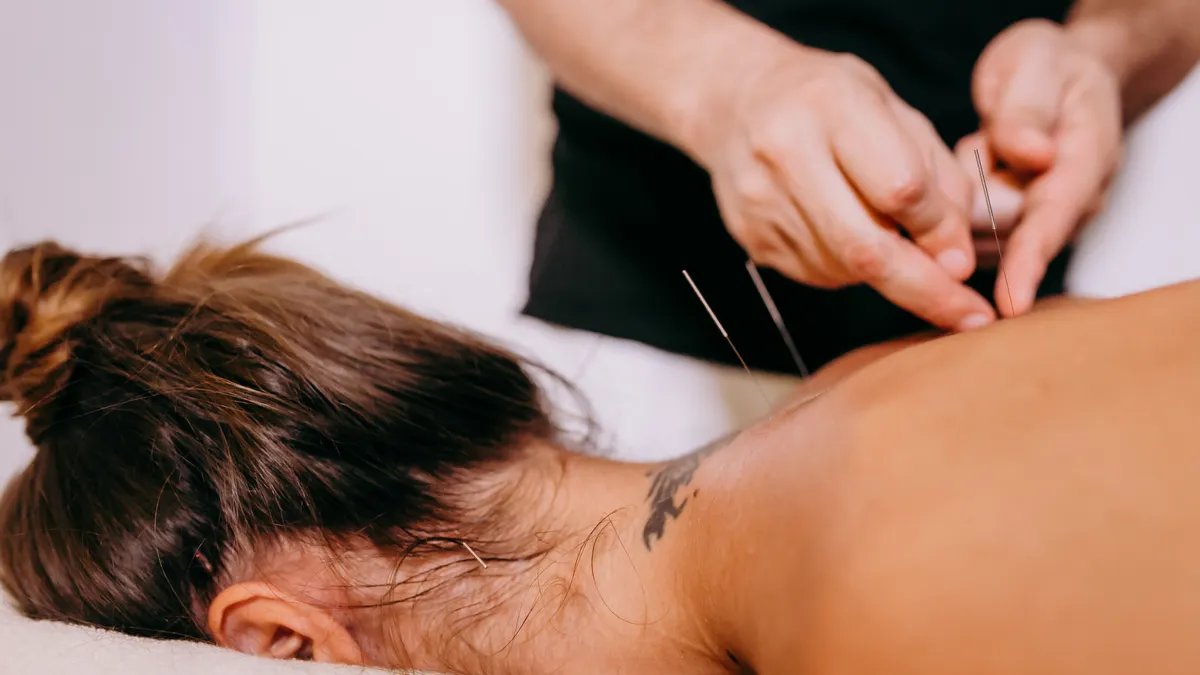
Acupuncture inserts very thin needles at chosen points, and the research shows its clearest results for several kinds of pain, including back, neck and knee pain. Part of the benefit comes from the needling itself and part from the setting around it.
- Origin
- Traditional Chinese medicine, at least 2,500 years of use
- Needles
- Solid, sterile, single use (FDA rules)
- Medicare
- Covered for chronic low back pain only
- Most common US reason
- Pain: back, joint or neck
What is acupuncture?
A technique in which a practitioner places fine needles into the skin, sometimes turned by hand or given a small electric current (electroacupuncture). The NCCIH notes that the World Health Organization found it in use in 103 of 129 countries reporting data. In the US, adult use went from 1.0% in 2002 to 2.2% in 2022.
Traditional schools explain it through the flow of qi along meridians. Modern researchers look at effects on the nervous system and on the tissues around each needle.
Does acupuncture work?
For pain, large pooled analyses say it does better than no treatment, with a smaller edge over sham needling.
| Condition | What reviews found |
|---|---|
| Back or neck pain | 2018: better than no treatment (8,003 people) and than sham (1,963 people) |
| Knee and hip osteoarthritis pain | 2018: better than no treatment (2,413 people) and sham (2,376), mostly knees |
| Pain after surgery | 2016: less pain and less opioid use (682 people) |
| Sciatica | 2015: may help, study quality too low for firm answers |
An analysis of 20 studies with 6,376 people found that benefits lasted a year after treatment for every condition studied except neck pain. The American College of Physicians put acupuncture among first-line non-drug options for chronic low back pain in 2017. These figures come from the NCCIH review of the evidence.
Sham comparisons also show why expectations matter: the belief of the patient and the relationship with the practitioner contribute to relief.
For myofascial trigger point pain, a combined analysis of a few studies found needling trigger points lowered pain (5 studies, 215 people), while needling traditional points did not (4 studies, 80 people). For battlefield acupuncture, an ear technique, a 2021 review of 9 studies (692 adults) found no significant improvement. Guidelines also differ by joint: in 2019 the American College of Rheumatology and Arthritis Foundation conditionally recommended acupuncture for knee, hip or hand osteoarthritis.
How does acupuncture work?
Several mechanisms seem to add up, and none explains it alone. The NCCIH reports evidence of effects on the nervous system, on the tissues around the needle (connective tissue in particular) and effects tied to the context of care. In one experiment, people who had earlier felt relief watched a video of their own session and imagined it again, which noticeably reduced their pain.
In practice, this means the practitioner matters: a calm room, a clear explanation and a plan you believe in are part of what you pay for.
What is the difference between acupuncture and dry needling?
Both use the same kind of needle, but with a different framework. The Cleveland Clinic describes dry needling as targeting myofascial trigger points, the tender knots in muscle, based on Western orthopedic assessment, usually as part of a pain program. Where state law allows it, trained physical therapists, athletic trainers, chiropractors or medical doctors perform it. Acupuncture follows an East Asian system and is performed by licensed acupuncturists.
What happens in an acupuncture session?
Questions, a short examination, then needles left in place. The practitioner reviews your history, finds the points, taps in the needles and may turn them gently. They may stay a few minutes up to about 20. Many people feel a small prick, then a dull ache or tingling. Most people come once a week at first, and a course usually runs over several visits.
Timing and visit frequency as described by the Cleveland Clinic.
How do you prepare for your first visit?
Come with your health history and loose clothing.
- List your medicines, especially blood thinners.
- Mention pregnancy, bleeding problems, skin infections and any implanted device.
- Eat something light beforehand and wear sleeves or trousers that roll up.
- Plan a ride or 5 to 10 minutes of rest before driving, since sessions can feel very calming.
- Agree on what improvement would look like, and when you will check it.
Many practitioners suggest taking it easy for a day or 2 after each session. A good first visit ends with a stated number of sessions to try and a date to review progress.
What are the risks of acupuncture?
Few complications are reported when sterile needles are used properly. Poor technique or nonsterile needles can cause infections, punctured organs or nerve system injury, the NCCIH reports. Under 21 CFR 880.5580, acupuncture needles are class II devices that must be sterile, biocompatible and labeled for single use.
The UK National Health Service names situations where it may not be safe: taking blood thinners or having a higher bleeding risk, and having a skin condition or infection.
Is acupuncture covered by insurance?
Sometimes. Medicare Part B covers acupuncture, dry needling included, only for chronic low back pain lasting 12 weeks or longer: up to 12 treatments in 90 days, with 8 more if you improve, 20 a year at most. The treatment has to come from a doctor, nurse practitioner, physician assistant or other provider who also holds a master's or doctoral degree in acupuncture and a current state license: Medicare does not pay licensed acupuncturists directly. You pay 20% of the approved amount after the deductible. Private plans differ; NCCIH reports that the share of adult visits with some coverage rose from 41.1% in 2010 to 2011 to 50.2% in 2018 to 2019. Medicaid varies by state.
How do you choose an acupuncturist?
Check the state license, then ask how they work.
- Is your license active in this state?
- Do you use sterile, single-use needles? (The federal rule requires it.)
- How often have you worked with my kind of complaint?
- How many visits before we judge the result?
- What does the first visit cost, and the follow-ups?
Styles differ: some practitioners work strictly within traditional Chinese theory and balance qi along meridians, others follow a modern anatomical approach, and many mix both. Auricular acupuncture limits needles to points on the ear. Ask which approach you are getting, and whether electroacupuncture is part of it, so you can mention any implanted device.
How do you become an acupuncturist?
Most states require a license, with rules that differ from state to state. O*NET shows a median wage of $76,040 a year in 2025, 14,800 acupuncturists employed and much faster than average growth projected to 2035. Compare acupuncture certification programs before you commit.
Also on our therapies list: gua sha, often paired with East Asian bodywork.
Frequently asked questions
Does acupuncture hurt?
Usually little. The needles are much thinner than injection needles and are solid, so most people describe a small prick, then pressure or tingling.
How many sessions before judging results?
The Cleveland Clinic advises at least 5 treatments, since benefits may show only in later sessions. Medicare's own rule continues coverage past 12 visits only if there is improvement, a useful checkpoint to agree with your practitioner.
Is cupping part of acupuncture?
Cupping is a separate technique from the same East Asian tradition; some acupuncturists offer both.
What is electroacupuncture?
It is acupuncture in which a small electric current passes between pairs of needles. Tell the practitioner about a pacemaker or another implanted device before a session.
Can you exercise after acupuncture?
Gentle activity is fine for most people. Many practitioners suggest keeping the rest of the day light, especially after a first visit.
Sources
- Acupuncture: Effectiveness and Safety, National Center for Complementary and Integrative Health
- 21 CFR 880.5580, Acupuncture needle, Code of Federal Regulations (LII)
- Acupuncture coverage, Medicare.gov
- Acupuncture, NHS
- Dry Needling, Cleveland Clinic
- Acupuncturists 29-1291.00, O*NET OnLine, US Department of Labor, 2025
- Acupuncture, Cleveland Clinic, 2023