Kefir: what it is, benefits and side effects
By the Naturomag editorial team · Published
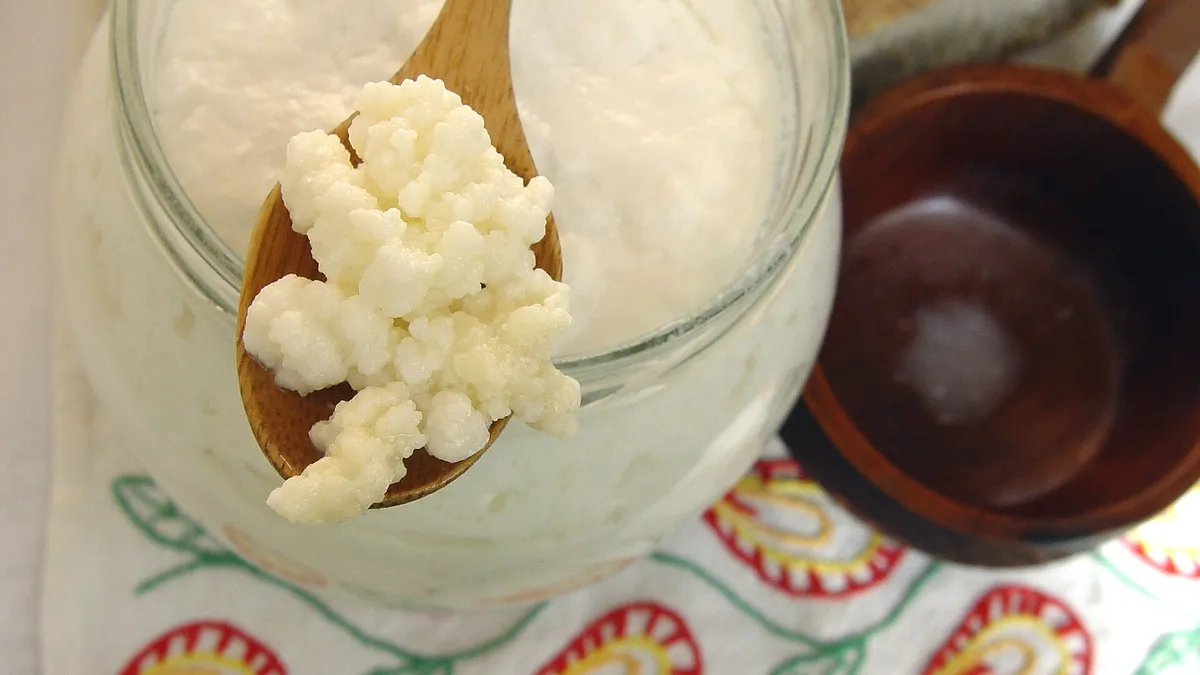
Kefir is a tangy, drinkable fermented milk made with kefir grains, small clusters that hold bacteria and yeasts. It brings protein, calcium and live cultures, which earns it a place among the healing foods in our nutrition section.
- Made from
- Milk and kefir grains
- Texture
- Pourable, tart
- Plain low-fat, per 100 g
- 37 kcal, 3.1 g protein, 107 mg calcium
- Human trial to know
- Lactose digestion
What is kefir made of?
Milk plus a very particular starter. The Codex Alimentarius standard for fermented milks defines kefir by its starter culture, prepared from kefir grains: Lactobacillus kefiri and species of Leuconostoc, Lactococcus and Acetobacter, with yeasts that ferment lactose and others that do not.
The grains are not cereal. They are a rubbery matrix of protein and sugars that holds the microbes, which a 2016 scientific review describes as a symbiosis of lactic acid bacteria and yeasts. Under the Codex standard, kefir also meets these marks:
- At least 2.7% milk protein
- Less than 10% milk fat
- At least 0.6% acidity, expressed as lactic acid
- At least 10 million starter bacteria per gram and 10,000 yeasts per gram until the date of minimum durability
What nutrition is in a glass of kefir?
A 240 g glass of plain low-fat kefir has about 89 kcal, 7.4 g of protein and 257 mg of calcium. That calcium is about 20% of the US Daily Value. The figures come from Health Canada's Canadian Nutrient File and the FDA reference of 1,300 mg.
| Per 100 g | Plain low-fat kefir | Kefir, 2 to 3.9% fat | 1% milk |
|---|---|---|---|
| Energy | 37 kcal | 63 kcal | 42 kcal |
| Protein | 3.1 g | 3.5 g | 3.4 g |
| Fat | 1.4 g | 3.6 g | 1.0 g |
| Lactose | 3.0 g | 3.8 g | 5.2 g |
| Calcium | 107 mg | 114 mg | 125 mg |
What are the benefits of kefir according to studies?
The most direct human result concerns lactose. In a 2003 trial with 15 adults who digest lactose poorly, each test meal held 20 g of lactose. Breath hydrogen, a sign of undigested lactose, reached 224 ppm x h with milk, 87 with plain kefir and 76 with plain yogurt. Flavored kefir landed in between at 156. Compared with milk, the yogurts and kefirs cut the perceived severity of gas by 54 to 71%.
Fermented foods as a group have also been tested. A Stanford trial published in Cell followed healthy adults: a diet high in fermented foods, kefir among those eaten by participants, steadily increased the diversity of gut microbes and lowered markers of inflammation.
How is kefir different from yogurt?
Yogurt is defined by 2 bacteria, kefir by a wider community that includes yeasts. Codex names Streptococcus thermophilus and Lactobacillus delbrueckii subsp. bulgaricus for yogurt.
| Point | Kefir | Yogurt |
|---|---|---|
| Starter | Kefir grains: bacteria and yeasts | 2 bacterial species |
| Texture | Pourable | Spoonable in its classic form |
| Taste | Tart, sometimes lightly fizzy | Tart and creamy |
| Minimum acidity (Codex) | 0.6% | 0.6% |
Products sold as kefir yogurt or drinkable yogurt are not all the same thing. Check which cultures the ingredient list names.
Does kefir fit a weight loss plan?
It can, mainly as a swap. Plain low-fat kefir has 37 kcal per 100 g. The fruit-flavored low-fat version in the same database has 60 kcal per 100 g, so compare labels. Plain kefir with fruit in place of a sweetened dessert saves sugar; the overall diet decides the result on the scale.
What side effects and cautions go with kefir?
The main cautions concern immunity, milk and raw milk.
- The National Center for Complementary and Integrative Health states that the risk of harmful effects from probiotics is greater in people with severe illnesses or compromised immune systems, and names premature infants.
- Kefir is a milk product and carries milk proteins: it is off the menu with a milk allergy.
- Fermentation does not remove all lactose: the plain low-fat product in the table still has 3 g per 100 g.
- Kefir made from raw milk starts from a food the FDA describes as especially dangerous for people with weakened immune systems, children, older adults and pregnant women.
How do you drink and choose kefir?
Start plain, in a small glass, and see how it sits over a week.
- Pick a plain bottle that lists live cultures and no added sugar.
- Blend it with berries, or pour it over oats left overnight.
- Use it cold in dressings and dips: cooking heats the live cultures you bought it for.
- Keep it refrigerated and respect the date on the label.
Frequently asked questions
How do you pronounce kefir?
The American Heritage Dictionary gives it as keh-FEER, with a short e in the first syllable.
Can you make kefir at home?
Yes. Put kefir grains in pasteurized milk in a clean jar, leave it at room temperature until the milk thickens and turns tart, then strain the grains out and use them again.
Is water kefir the same drink?
No. It ferments sugared water or fruit liquid, while the standard quoted here applies to milk.
Is kefir a source of iron?
Barely, with about 0.1 mg per 100 g. For that mineral, turn to the list of iron-rich foods.
Sources
- Milk and milk products, 2nd edition: Standard for fermented milks (CODEX STAN 243-2003), FAO and WHO, Codex Alimentarius, 2011
- Canadian Nutrient File, Health Canada
- Daily Value on the Nutrition and Supplement Facts Labels, U.S. Food and Drug Administration
- Kefir improves lactose digestion and tolerance in adults with lactose maldigestion, Journal of the American Dietetic Association, 2003
- Gut-microbiota-targeted diets modulate human immune status, Cell, 2021
- Fermented-food diet increases microbiome diversity, decreases inflammatory proteins, Stanford Medicine, 2021
- The microbiota and health promoting characteristics of the fermented beverage kefir, Frontiers in Microbiology, 2016
- Probiotics: usefulness and safety, National Center for Complementary and Integrative Health, 2019
- The dangers of raw milk, U.S. Food and Drug Administration
- kefir, American Heritage Dictionary