Tea tree oil: benefits, uses and how to dilute it
By the Naturomag editorial team · Published
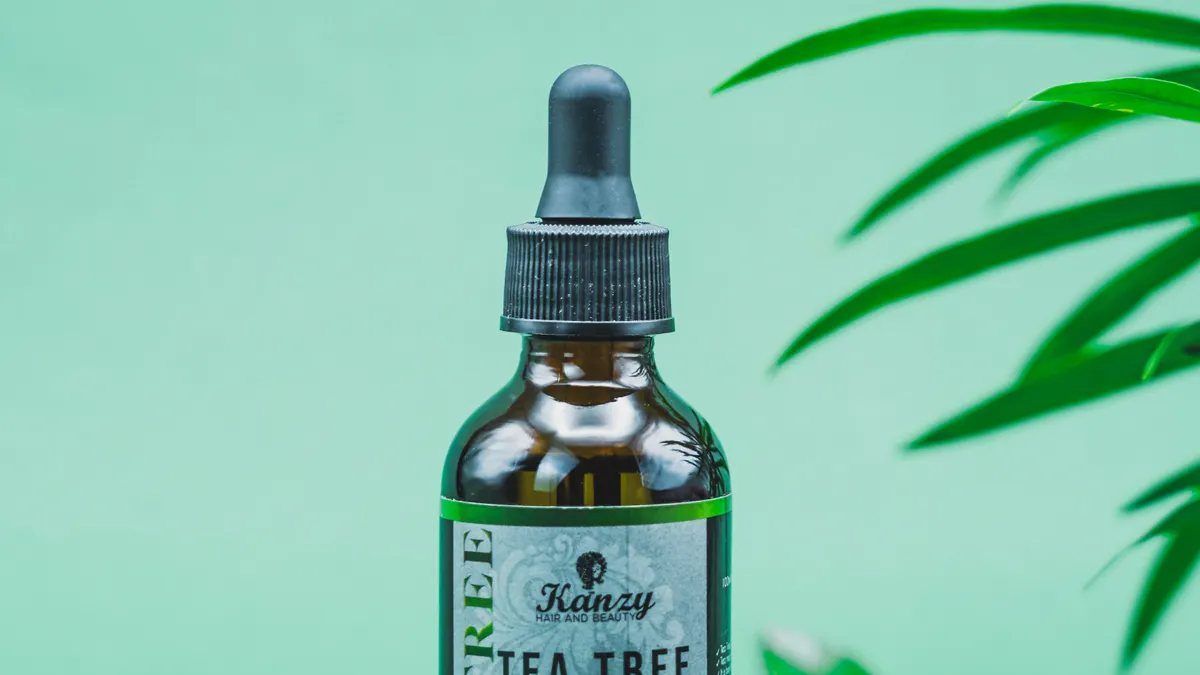
Tea tree oil is used on the skin for mild acne, small wounds and insect bites, mild athlete's foot and minor mouth irritation: these are the 4 traditional uses in the European monograph. Trials also tested it on dandruff and nails, and the one hard rule is that you never swallow it.
- Latin name
- Melaleuca alternifolia (Australian tea tree)
- Made by
- steam distillation of the leaves
- Use on
- skin; mouth rinse or gargle without swallowing
- Age
- 12 and up in the monograph
- Never
- swallowed, inhaled, put in eyes or ears
Where does tea tree oil come from?
From the leaves of a plant native to New South Wales and Queensland in Australia. Aboriginal Australians traditionally used the leaves on wounds, burns and insect bites. Most commercial oil is produced in Australia, with China and several African countries also supplying it (NCCIH). It is a different plant from the tea you drink.
Which tea tree uses and amounts does the monograph set?
The EMA monograph names 4 traditional uses, each with its own preparation and time limit.
| Use | Preparation | How often | Limit |
|---|---|---|---|
| Small wounds, insect bites | 0.03 to 0.07 mL pure oil on a cotton bud, or a 0.5 to 10% liquid | 1 to 3 times a day | 1 week |
| Small boils, mild acne | 10% oily or semi-solid product; or 0.7 to 1 mL in 100 mL lukewarm water as a compress; or pure oil on a boil with a cotton bud | 1 to 3 times a day (bud: 2 to 3) | 1 month |
| Mild athlete's foot (itching, irritation) | 10% product; or a 5 to 10 minute foot soak with 0.17 to 0.33 mL; or pure oil on a cotton bud | 1 to 3 times a day (soak: once) | 1 month |
| Minor mouth lining irritation | 0.17 to 0.33 mL in 100 mL water, rinse or gargle | several times a day | 5 days |
How do you dilute tea tree oil with a carrier oil?
Mix a measured volume into a plain vegetable oil: 5% is the strength of the acne gel and dandruff shampoo trials, 10% the one the monograph sets for acne and athlete's foot products.
| Strength | Tea tree oil | Carrier oil to make 30 mL |
|---|---|---|
| 5% | 1.5 mL | 28.5 mL |
| 10% | 3 mL | 27 mL |
Jojoba, sweet almond or fractionated coconut oil are common carriers. Pick one you already tolerate on your skin. Measure with a syringe or measuring cylinder, since drop sizes vary from bottle to bottle.
What did trials find for acne?
A 5% gel reduced mild to moderate acne in 2 controlled trials. In a 1990 Australian study of 124 people, 5% tea tree gel and 5% benzoyl peroxide lotion both reduced lesions; tea tree worked more slowly with fewer side effects. In a 2007 trial of 60 people over 45 days, the 5% gel beat placebo on lesion count and severity. The NCCIH sums up the evidence as small and promising.
Does tea tree oil work on athlete's foot and toenail fungus?
For athlete's foot between the toes, a trial found a clear difference; for nails, the evidence is limited.
- Foot: in a 2002 trial of 158 people, 25% and 50% solutions applied twice daily for 4 weeks gave a marked response in 72% and 68%, against 39% on placebo. These strengths are well above the monograph's 10%, and 3.8% developed moderate to severe dermatitis that settled after stopping.
- Toenails: in a 1994 trial of 117 people, 100% tea tree oil and 1% clotrimazole solution, applied twice daily for 6 months, gave similar results: partial or full clearing in about 60%, negative cultures in 18% with tea tree and 11% with clotrimazole.
The NCCIH judges the nail research too limited to draw a conclusion. Nails grow slowly, so any change takes months to show.
What about tea tree shampoo and soap?
The shampoo has a trial for dandruff; soap rinses off in seconds. In a 2002 trial of 126 people aged 14 and up, 5% tea tree shampoo used daily for 4 weeks improved the dandruff score by 41%, against 11% for placebo, with no adverse effects reported. Tea tree soap is mainly a cleanser. Under U.S. cosmetics rules, a product intended only to cleanse is a cosmetic. Check how much tea tree oil the label states, and where it sits in the ingredient list.
Is tea tree oil a natural antibiotic?
No: it is a topical antiseptic oil, not an antibiotic medicine. A 2006 review describes its antimicrobial activity against bacteria and fungi, mostly measured in the laboratory. That activity explains its long use in Australia, where it has been used for almost 100 years. It goes on skin, never down the throat.
What are the risks and who should skip it?
Do not use it if you are allergic to tea tree oil or to colophony (rosin), and never swallow it.
- Swallowed: confusion, loss of coordination, inability to walk and coma have been reported (NCCIH). The monograph treats ingestion by a child as an emergency.
- Skin: smarting, itching, redness, swelling and, rarely (under 1 in 1,000), burn-like reactions. Stop at the first rash.
- Old oil: exposure to heat, light or air makes irritation more likely.
- Pregnancy and breastfeeding: the EU monograph does not recommend use, as safety is not established; the NCCIH states that products used on the skin may be safe.
- Under 12: use not established.
- Pets: it is on the list of oils known to poison cats (Pet Poison Helpline).
Where can you study tea tree and other oils?
Aromatherapy programs teach oil chemistry, dilution and safety. Compare aromatherapy courses and their hours, or request program information below. For a far hotter, phenol-rich oil, see how oregano oil behaves on skin. Tea tree is not an oil to inhale: our diffuser guide covers what people run at home, and essential oil safety rules apply to every bottle.
Frequently asked questions
Can I use tea tree oil straight from the bottle?
The monograph allows small amounts of pure oil on a cotton bud for specific spots, such as a boil or insect bite. For wider areas, use a diluted product.
Can I put tea tree oil in my mouthwash?
The monograph describes a rinse or gargle of 0.17 to 0.33 mL in 100 mL of water, spat out, for up to 5 days.
Does tea tree oil expire?
It oxidizes. Keep it tightly closed, away from light and heat, and replace an old bottle.
Sources
- European Union herbal monograph on Melaleuca alternifolia, aetheroleum (EMA/HMPC/320930/2012), European Medicines Agency, HMPC, 2015
- Tea Tree Oil, National Center for Complementary and Integrative Health (NCCIH)
- A comparative study of tea-tree oil versus benzoylperoxide in the treatment of acne (Bassett et al.), Medical Journal of Australia, 1990
- The efficacy of 5% topical tea tree oil gel in mild to moderate acne vulgaris (Enshaieh et al.), Indian Journal of Dermatology, Venereology and Leprology, 2007
- Treatment of interdigital tinea pedis with 25% and 50% tea tree oil solution (Satchell et al.), Australasian Journal of Dermatology, 2002
- Comparison of two topical preparations for the treatment of onychomycosis (Buck et al.), Journal of Family Practice, 1994
- Treatment of dandruff with 5% tea tree oil shampoo (Satchell et al.), Journal of the American Academy of Dermatology, 2002
- Melaleuca alternifolia (Tea Tree) oil: a review of antimicrobial and other medicinal properties (Carson et al.), Clinical Microbiology Reviews, 2006
- Aromatherapy, U.S. Food and Drug Administration, 2023
- Essential Oils and Cats, Pet Poison Helpline