Essential oil diffuser: which type to buy and how to run it
By the Naturomag editorial team · Published
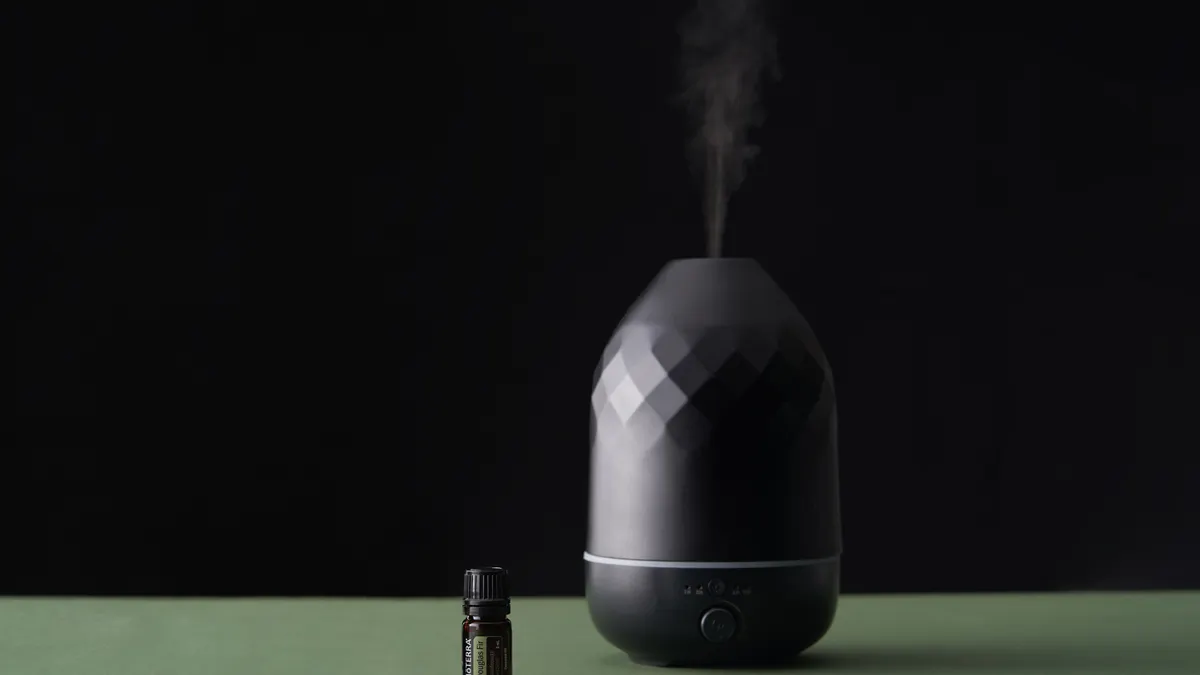
An essential oil diffuser spreads the scent of oils into a room, and for most bedrooms and desks an ultrasonic model with an automatic shut-off is the sensible pick. Nebulizers give a stronger scent from undiluted oil, heat and reed models are the simplest, and pets change the whole decision.
What are the main types of diffusers?
| Type | How it works | Choose it if |
|---|---|---|
| Ultrasonic | vibrations turn water plus a few drops into a cool mist | you want gentle scent and a bit of moisture |
| Nebulizing | a fast air stream atomizes oil without water | you want a strong scent in a larger space and accept higher oil use |
| Heat (plug-in, candle, warmer) | warmth evaporates the oil | you want something silent and cheap |
| Reed | sticks wick up a scented liquid | you want a constant light background with no power |
| Fan and pad | air blows through an oil-soaked pad | you want scent with no water |
| Wearable (pendant, bracelet) | room air carries the aroma from you | you want it for yourself only |
Ultrasonic and nebulizing models are "active" diffusers: they put tiny droplets of oil into the air, not only a smell. The others evaporate it (Pet Poison Helpline). A reed diffuser liquid is often essential oil in rubbing alcohol, so keep it away from children (Poison Control).
What is the best essential oil diffuser for you?
The best one matches your room size and your household, so judge on features rather than brand.
- Bedroom: ultrasonic, quiet, with a timer and automatic shut-off when the water runs out.
- Office desk: small ultrasonic or a wearable, so colleagues are not made to share it.
- Large living room: a nebulizer, run in short bursts.
- Small children at home: place it high and stable, or choose none.
- Cats or birds: read the pet section before buying anything.
Check the tank can be opened and scrubbed, the cord is long enough to reach a stable surface, and the maker states which oils the plastic can handle.
How do you use and clean a diffuser?
Follow the maker's oil quantity, run it in a ventilated room, and clean the tank often. Ultrasonic diffusers use the same mist principle as ultrasonic humidifiers, for which the EPA gives rules that apply well:
- Empty the tank, dry the surfaces and refill with fresh water every day of use.
- Use low-mineral water, such as distilled, to limit mineral dust in the air.
- Clean thoroughly every 3rd day and remove scale or film.
- Without other maker instructions, the EPA suggests a 3% hydrogen peroxide solution, then several rinses.
- Unplug before cleaning, and stop if walls or windows collect water.
Essential oils are volatile compounds, and indoor sources of volatile compounds add up: the EPA advises more ventilation when using such products. Open a window and use short sessions.
Which oils suit a diffuser at bedtime?
Lavender is the usual choice, with a modest evidence base for inhaling it. In a 2012 study of 20 healthy volunteers, inhaled lavender oil lowered blood pressure, heart rate and skin temperature, and participants described themselves as fresher and more relaxed. The NCCIH says it is not known whether aromatherapy helps insomnia, since little rigorous research exists.
The European recognition of lavender to aid sleep concerns medicines taken by mouth or added to a bath, from age 12, not a diffuser (EMA). Use a timer so the device stops after you fall asleep.
Which oils do people diffuse during cold and flu season?
Eucalyptus and peppermint are the 2 with a European monograph for coughs and colds, as measured preparations rather than room scent. Eucalyptus oil is recognized for the cough of a common cold, with inhalation from age 4; eucalyptus medicines are ruled out under 30 months and for children with a history of seizures. The peppermint monograph covers symptoms of coughs and colds, with inhalation from age 12, and rules it out under age 2 because menthol can trigger reflex breathing arrest and spasm of the voice box.
These amounts are made to be inhaled, for instance in hot water vapor. A diffuser scents the room: follow its maker's quantity, and keep eucalyptus and peppermint away from babies and cats.
Are diffusers safe around pets and children?
Cats are the most exposed, and birds should not share a room with one. Cats lack a liver enzyme that handles some of these compounds, and droplets can land on fur and be licked off. Oils known to poison cats include tea tree, peppermint, eucalyptus, cinnamon, clove, citrus (d-limonene), ylang ylang and wintergreen (Pet Poison Helpline). Drooling, vomiting, wobbliness or breathing trouble are warning signs, and the cat should be moved to fresh air at once.
The ASPCA adds that short use in an area a dog or cat cannot reach is unlikely to be a problem, but it advises against diffusers in homes with birds, and with pets that have breathing problems. For children, bottles stay locked away: even small swallowed amounts of some oils can harm.
Which oils should you put in it first?
Start with 1 oil, labeled by its Latin name, in a small amount. Leave tea tree out: its monograph rules out inhalation and it is toxic to cats, as set out in our tea tree oil guide. Strong phenol oils are not a first choice either; see why oregano oil irritates. For the basics on dilution and bottles, see how to choose an essential oil bottle. To blend with method, compare aromatherapy certification courses.
Frequently asked questions
How long should I run a diffuser?
Short sessions with the window open or the door ajar work better than running it all day. Use the timer.
Can I use tap water in an ultrasonic diffuser?
Low-mineral water is the better choice: the EPA recommends it for ultrasonic humidifiers to limit minerals released into the air.
Do I need water for a nebulizing diffuser?
No. A nebulizer atomizes the oil itself, which is why it uses more oil.
Can essential oils cause headaches?
Strong fragrances can irritate some people. Headache is on the EPA list of effects linked to volatile compounds, so ventilate and stop if you notice it.
Sources
- Essential Oils and Cats, Pet Poison Helpline
- The Essentials of Essential Oils Around Pets, ASPCA, 2022
- Essential oils: poisonous when misused, Poison Control (National Capital Poison Center)
- Use and Care of Home Humidifiers, U.S. Environmental Protection Agency
- Volatile Organic Compounds' Impact on Indoor Air Quality, U.S. Environmental Protection Agency
- Aromatherapy, National Center for Complementary and Integrative Health (NCCIH), 2020
- The effects of lavender oil inhalation on emotional states, autonomic nervous system, and brain electrical activity (Sayorwan et al.), Journal of the Medical Association of Thailand, 2012
- Lavender oil (Lavandulae aetheroleum): summary of HMPC conclusions, European Medicines Agency
- Eucalyptus oil (Eucalypti aetheroleum): summary of HMPC conclusions, European Medicines Agency
- European Union herbal monograph on Mentha x piperita L., aetheroleum, revision 1, European Medicines Agency, HMPC, 2020